


Holy Martyr John the Wallachian
Troparion of the Saint (Tone IV)
Today the Church spiritually celebrates the faithful, and joyfully cries out: Come, lovers of martyrs, let us celebrate the annual commemoration of the struggles of the new martyr John! For he, rising among us by the will of God, in the imperial city of Constantine flourished wonderfully, bringing to the Master rich and well-received fruit, through martyrdom. And now he prays unceasingly in heaven, that our souls may be saved.

(Celebrated on May 12)
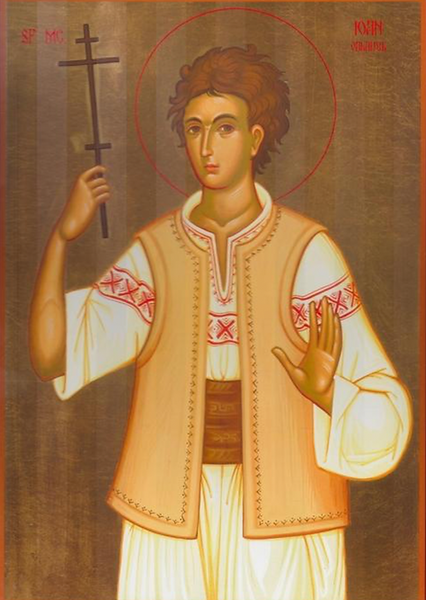
Although he was so young, Saint John had already attained the measure of the stature of the fullness of Christ.
Many regions of the world have been deemed worthy to enrich Paradise with an abundance of chosen souls who forever partake of the unsetting light of God. Among these, the borders of the Romanian people have been no poorer than others. From the spirit of the Romanian people there have sprung souls who ascended into the choir of the righteous; from its blood were formed bodies that did not suffer the corruption of death; beneath its altars were laid the members of martyrs who, through suffering, bore witness to the power of the spirit in Christ; through its mountains hermits were saved in radiant holiness, consuming themselves in prayer, fasting, and vigil; and on not a few episcopal thrones labored hierarchs who, beyond the golden and jeweled crown of common esteem, added to themselves the imperishable crown of sanctity.
Glory be to God for His gifts, for He has not shamed us before other nations by depriving us of near intercessors. Though these saints, together with all the saints, intercede for us in the language of the angels—above every human tongue—they nevertheless zealously remember us, the bearers of the language in which they confessed Christ here on earth. Although they bear spiritual countenances, above every likeness of blood and flesh, they are there the icon-bearers of our own faces, as those perfected in the temples of the Holy Spirit. And although they dwell in the city of light, above every kingdom, they watch over us in a special way, like sleepless guardians of their earthly city.
Through their saints, all the nations of the earth proceed from God and are made whole in God, just as the colors of the rainbow proceed from the sun and are gathered again into the sun. And as the dew of the earth reflects the sun and arches its light across the sky for our delight, so the saints of heaven reflect the invisible God and arch His glory across the ages, saving us by His power. Glory be to God that upon the soil of our land He has poured an abundant rain of grace, from which has formed the saving dew of our saints.
One such drop of spiritual refreshment is Saint John the New Martyr of Wallachia. He is called “New” because he suffered after 1453, when Constantinople fell to the Turks; and he is called “the Wallachian” because he was by birth from Wallachia, that is, from the Romanian Land. It is known that in ancient times foreign peoples called the Romanians Vlachs or Wallachians, that is, a people of Latin origin, and this remembrance is preserved to this day in the name of the Holy Metropolis of Ungro-Wallachia.
The blessed Martyr John lived his earthly life in the middle of the seventeenth century after Christ. At that time, not long after the pious reign of Prince Matei Basarab, the throne of Wallachia was taken by Prince Mihnea, whom the people nicknamed “the Turkified.” Although he claimed to be Romanian, this Mihnea was the son of a Greek moneylender and, from an early age drawn to the customs of the Hagarenes—that is, the worshipers of Allah and venerators of Muhammad—he fled from his parents. He went to Constantinople and entered the service of Sinan Pasha, claiming to be the son of Prince Radu, and thus lived among the Turks and in their law for forty years. There he was called Gioan Bey and was entirely enslaved to the lust for vain glory. Paying the sultan many bags of gold, he became ruler of Wallachia and began to oppress the people with heavy taxes. The country continually resisted him, and he was able to remain on the throne only by repeatedly calling in the Tatars, who would invade in hordes, devastate the land, and carry off multitudes of captives. Eventually, unable to satisfy Ottoman greed and desiring some gain for himself, he refused to pay the tribute owed to Constantinople.
Thus Mihnea allied himself with two other princes and, after killing many of his own officials at court, launched a revolt against the Turks, cutting them down wherever he found them. Sultan Mehmed, hearing of this, sent a horde of Tatars into Moldavia, an army of Turks into Wallachia, and another into Transylvania. The Tatars prevailed in Moldavia and carried out a terrible devastation. In Wallachia, Mihnea defeated his opponents, but immediately afterward, seized by fear, he fled over the mountains, where he ended his life without salvation. The third army of the sultan defeated the Transylvanian voivode at Deva and, returning through Oltenia—then called Lesser Wallachia—crossed the mountains through the valleys of the Olt and Jiu rivers. It wrought great destruction among the Christians and enslaved vast numbers of men, women, and children, capturing them with snares and dragging them, bound with ropes, behind horses and wagons. This calamity occurred in the year 1659, in November or December.
Among those taken captive was the young John, a scion of a noble family, born and raised here in Wallachia, of parents devoted to faith, piety, and good household order. When John was taken captive, he was only fifteen years old.
Yet how wondrously God reveals Himself in His chosen ones! Though so young, John had attained the measure of the stature of the fullness of Christ, when the purity of a child’s heart is joined to the wisdom of an elder’s mind. He was handsome of countenance, bright of gaze, and well-proportioned in body. His constitution was full of health; youthful vigor coursed through his whole being. And though his neck was bent beneath slavery, his eyes shone with the power of faith and the hope of salvation. The wondrous body of the young man was like a church in which the censer of his pure and sacrificial soul sent up fragrant incense. Thus he walked the arduous road of captivity, drawing near to the Danube and leaving behind his parents, kindred, and beautiful homeland, not knowing that he would never return and that God was preparing for him another homeland, beyond every border—the Kingdom of Heaven. Yet into this kingdom one enters only through the narrow gate of ascetic struggle, after passing through the fire of many trials.
The captives of the Hagarenes were considered the property of the sultan, but they could be purchased by any worshiper of Allah for a suitable price, according to each one’s age and usefulness. Thus, while still on the road, a pagan among those leading the Romanians into captivity fixed his gaze upon John and, taking a liking to him, bought him with impure intent. For he was unable to perceive John’s inner beauty, fixing instead his lawless gaze upon outward comeliness. He began to force him to defile his body with the sin first devised in the accursed city of Sodom, which God burned with fire and brimstone for its iniquity—a sin condemned also by the divine Apostle Paul in his Epistle to the Romans (1:27). But John resisted the sin and armed himself with prayer and the sign of the Cross against the one who sought to defile him.
The Hagarenes said to him angrily, “Are you so proud before me, forgetting that you are nothing but a wretched slave?” John replied, “I am a slave only to Christ, and how wide is my freedom within this divine slavery!” The pagan scowled: “I am your master, for I bought you with gold; I can do with you as I wish.” The young man answered boldly, “Christ is my Master, for He redeemed me with the price of blood; He does with me what is right.” His mind grew strong in the power of faith. Then the Hagarenes prepared to bind him to a tree to violate him. But John, deeply revolted in his heart and unwilling to be shamed before God, armed himself with the memory of the young David, conqueror of Goliath, and of the soldier Nestor who overthrew the pride of Lyaios. Gathering courage, he seized a favorable moment and killed the pagan.
Soon afterward, the other Hagarenes noticed the absence of his master. Upon learning the truth, they bound John in chains and thus led him for a long time on the road to Constantinople. Who can describe the torment of one dragged among captives? It was winter, and the cold froze the young man’s naked body. Yet he endured manfully, thinking it better for his body to burn in the fire of winter than for his soul to burn in the fire of Gehenna. Who can know the hunger of his unfed belly, the bleeding of his bare feet, and the exhaustion of his weary limbs? Along the harsh road through the snowbound passes of the Balkans and the Rhodopes, the blizzard lashed his face, filled his eyes with tears, and bent his back. Yet his spirit remained upright, though he foresaw the torments awaiting him at journey’s end, knowing that the killing of a Turk could not go unpunished.
Thus, bound, he reached Constantinople, where winter was no longer winter, but slavery was still slavery. His guards brought him before the wife of the slain man, recounting all that had happened. Observing her law, the Hagarenes’ wife presented John to the vizier for judgment. John was examined and confessed the truth—that by killing the pagan he had done nothing but defend his Christian purity. The vizier handed him over to the dead man’s wife, to do with him as she pleased.
Sharp are Satan’s temptations against the confessors of Christ, yet God permits them so that the power of faith may ascend. The greater the temptations overcome, the more unfading is the crown of glory of the victor. John had been given beauty of body, and through bodily beauty he was tempted.
The young widow was immediately captivated by John’s beauty and brought him to her splendid dwelling, where the spirit of lust reveled on carpets and divans, nourished by rich foods and poisonous fragrances. She said to him, “Behold, you are in my power! Since you killed my husband, you shall take his place and be my husband. From a slave I make you free; from a poor man, rich. But to be my husband, you must share my law. Nothing is easier than to renounce Christ and become a worshiper of Allah and a follower of Muhammad, his prophet. Look around at the gold and silver, the silks, the precious stones; look at me, standing ready beside you.”
The temptation was not light for the young John: to exchange iron chains for silk garments; to soothe the serpents of hunger with abundant feasts; to trade the toil of the road for comforting rest; to replace the lash of the blizzard with gentle breezes; to cease bleeding on mountain rocks and instead glide in a boat upon the waters of the Bosphorus.
Yet John was full of virtue and did not yield. Boldly he replied, “I shall preserve the purity of my soul and will not pass over to your law; I shall guard the undefilement of my body and will not unite myself with you.” The woman said to him, “There was here in Constantinople a young man of your people, named Gioan Bey; he grew up in the courts of the seraglio, enjoyed the charms of the sultana, and became rich and ruler in your land. I do not say you will become ruler, but Constantinople is a crossroads of many paths to power and glory.”
The righteous young man did not need long to consider and replied from the treasure of ancestral tradition: “I do not know what became of that ruler, who fled over the mountains in fear of you, but I know the people call him ‘Mihnea the Turkified,’ and by that shameful name he will be remembered. I do not wish to be ashamed of my name.”
Once more John lifted up prayer to Christ the Savior and armed himself with the sign of the Cross, that he might be preserved and strengthened to the end, unwavering in the faith of his fathers. He remembered Joseph, the son of Jacob, who resisted the enticements of Potiphar’s wife in Egypt, and this remembrance enlightened and strengthened him exceedingly.
The pagan woman tried every art to turn the young man from Christ and to unite him with her, for she was tormented by passion and had no peace. These temptations lasted nearly two and a half years, as the young man matured in body. Yet John did not waver from the firm foundation of his Orthodox faith.
Finally, seeing herself utterly defied, the Hagarenes unleashed her pagan fury and delivered John to the eparch, the governor of the city, who cast him into prison. There the martyr was subjected to so many terrible and fearsome tortures that even to imagine them is enough to fill one with dread.
The torments lasted several days, and even then John was not without temptation. For the woman, still inflamed by his beauty, came daily to the prison, enticing him with flattery and promises toward defilement and apostasy. But the young man, like a diamond, remained unshaken in faith and wisdom, looking only to Christ the Lord, from whom he received strength and victory over visible and invisible enemies. With an elder’s mind dwelling in a youthful body, illumined by God’s grace, he knew that the purity of both soul and body must be preserved whole, as a sacrifice pleasing before Heaven.
At last, seeing that their labors were in vain and that they could gain no victory over John, they sought permission from the vizier to kill him. The vizier ordered the eparch to carry it out. Thus the executioners who had tortured him took the blessed young John and led him to Parmak-Kapi, near the Bezestan in Constantinople, to kill him by hanging. And he, made radiant by suffering and illumined by the grace of holiness, went toward the place of his martyrdom, giving thanks to God. The eyes of his spirit, fixed beyond the horizons of this age in the everlasting Kingdom of light, beheld the reward for the chains of slavery, the lashes of the icy wind, the bodily struggles, and the torments of the prison. He saw garments more precious than the silks of the East, felt consolations sweeter than the breezes of Constantinople, and wept with a joy incomparable to earthly delights.
Thus, in the year 1662, on the twelfth day of May, the ever-blessed young John received from the hand of the Lord the crown of victory. His life and passion were written by John Karyophilos, a learned Greek of his time, and later printed in Venice by Saint Nicodemus of the Holy Mountain, from where it entered the Greek and then the Romanian synaxaria. Thus the name of Saint John the New Martyr of Wallachia was written in the Book of Life of God, and his remembrance is kept in the heart of the people who gave him birth.
Through his holy prayers, may God deem us also worthy of the unfailing and eternal good things. Amen.