


HISTORICAL
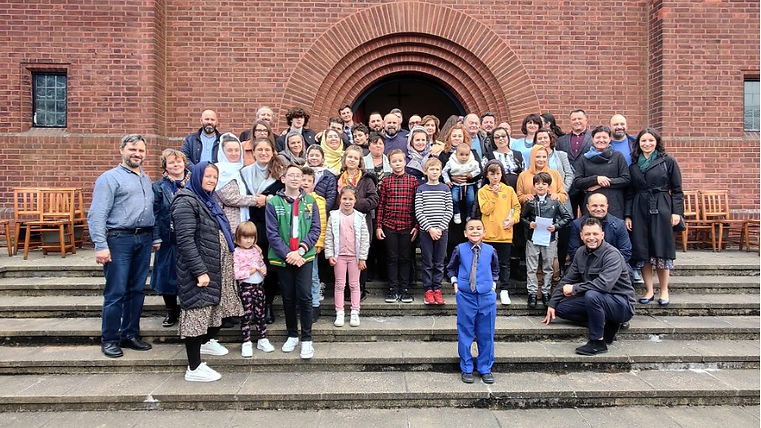
The Romanian Orthodox Parish "Saint Martyr John the Wallachian" in Wolverhampton was established as an expression of the Church's pastoral care for the Romanian Orthodox faithful in this part of Great Britain. Founded on October 2, 2022, with the blessing of His Eminence Father Iosif, Metropolitan of Western and Southern Europe, the parish is part of the Church's steadfast mission to confess the true faith and to strengthen the spiritual life of the Romanian community in the diaspora.
Protected by the Holy Martyr John the Wallachian, a young confessor of Christ and a luminous image of sacrifice and spiritual purity (Find out about his life and miracles here ), the parish organizes its liturgical, pastoral and missionary work in the spirit of fidelity to the Orthodox Tradition and the spiritual values of the Romanian people.
The parish's activity is carried out under the canonical guidance of His Eminence Father Athanasius, Archbishop of Great Britain and Northern Ireland, and the pastoral ministry is entrusted to the priest Ștefan Florescu.
Holy services are celebrated in the place of worship located at WV3 0RJ, Merridale Street West, Wolverhampton, and the Sunday liturgical program includes Matins at 8:00 a.m. and Holy Mass at 10:30 a.m.
Through the celebration of the Holy Sacraments, the preaching of the Gospel and social-philanthropic work, the Romanian Orthodox Parish "Saint Martyr John the Wallachian" in Wolverhampton assumes the call to be a living altar of faith, unity and Orthodox confession in the midst of the Romanian community in the diaspora.
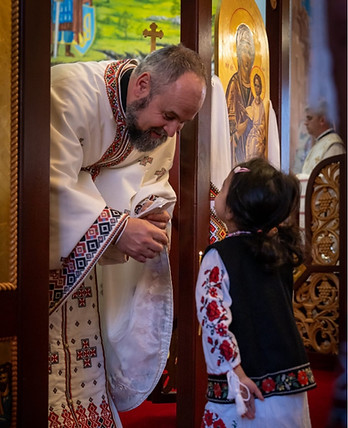
Parish Priest Gheorghe Ștefan Florescu
Father Gheorghe Ștefan Florescu was ordained parish priest in July 2008, at the "Saint Nicholas" Church in Valea Babei village, Runcu commune, Vâlcea county, Romania, where he served until August 9, 2015.
Between September 2015 and September 2022, he was a serving priest of the "Saint Andrew" Romanian Orthodox Church in Birmingham, and since October 2, 2022, he has been the parish priest of the Saint John the Wallachian Romanian Orthodox Church in Wolverhampton.
The Lives of the Venerable Saints Silas, Paisios and Nathan of the Putna Hermitage and the Holy Martyr Sabina of Rome
The Holy Venerable Fathers Sila, Paisius, and Nathan struggled in ascetic life in the 18th century at the Hermitage of Putna (Sihăstria Putnei), a place of quietude where monks devoted to greater prayer and ascetic labor would withdraw.
Saint Venerable Sila was born in 1697 in the region of Botoșani, to Orthodox parents, Ion and Ioana. While still very young, he entered as a novice brother at the Orășeni Skete (Cristești commune, Botoșani County). In 1714, at the age of seventeen, he came to the Hermitage of Putna, where he was received and later tonsured a monk by Abbot Theodosius. After the latter’s repose, Abbot Dosoftei, the new spiritual father of the skete, arranged for him to be ordained deacon and priest, and shortly thereafter he was tonsured into the Great Schema.
As disciple and assistant to Abbot Dosoftei, the hieroschemamonk Sila took care for more than thirty years of all the needs of the brotherhood, while at the same time laboring in the church services and in fulfilling his cell rule. In the autumn of 1753, after Abbot Dosoftei passed to the Lord, Venerable Sila was appointed abbot by the Metropolitan of Moldavia, Saint Jacob of Putna. As spiritual father of the brotherhood, he renewed the spiritual life of the Hermitage of Putna, and as a wise administrator, with the blessing of Metropolitan Jacob, he built a new stone church dedicated to the Annunciation, adorning it with all that was necessary, as well as a new refectory and monastic cells. Having become a renowned spiritual father and guide of souls, Venerable Sila was esteemed both by the simple faithful and by the rulers of Moldavia, Constantin Racoviță and Grigorie Callimachi, as well as by high officials, abbots, and hierarchs, all of whom he guided wisely on the path of salvation. Under the guidance of the holy abbot, the monks of the skete occupied themselves with copying manuscripts containing holy services and important writings of the Holy Fathers. Among his disciples, the best known is Dosoftei Herescu, Bishop of Rădăuți.
The last years of Venerable Sila’s life were marked by many hardships and trials, as a result of the annexation of Bukovina by the Habsburg Empire in 1774 and the restrictions imposed by the new administration. The skete lacked the necessities for feeding the monks and was forced to borrow money and food. Knowing the nearness of his earthly end, Saint Sila appointed Venerable Nathan as guide of the Hermitage of Putna, then asked forgiveness of all. On April 23, 1783, after nearly seventy years of ascetic life at the Hermitage of Putna, the venerable hieroschemamonk Sila peacefully surrendered his soul into the hands of the Lord, whom he loved and served throughout his life.
Saint Venerable Paisius was born in 1701 and entered monastic life at a young age. For his virtue he was ordained deacon and then priest, and became abbot of Saint Elijah Monastery, from where he later went to Râșca Monastery. After some time he came to the Hermitage of Putna, living in deep humility. Although he was not abbot of the Hermitage, he was a fervent man of prayer, strengthening all in the Orthodox faith, especially during the time of foreign rule. He also received from God the gift of foresight, which, added to his other virtues, made him honored by all as a great spiritual father. Together with Abbots Sila and Nathan, he witnessed the hardships of the years of Austrian rule, yet proved himself a zealous ascetic. He reposed peacefully on December 16, 1784.
Saint Venerable Nathan was born in 1717, being a native of Pașcani. He was first a monk and ecclesiarch at Putna Monastery, where he was ordained deacon and then priest. Desiring greater prayer and quiet, he withdrew to the Hermitage of Putna, where he received the Great Schema with the name Nathan. Venerable Nathan was known as a very discerning spiritual father and was also the confessor of the great Metropolitan Jacob of Putna. At the same time, the ascetics of the hermitage, his fellow strugglers, as well as the faithful pilgrims, honored him as a true father and guardian of Orthodox order. He was also engaged in copying manuscripts and compiling commemorative lists of benefactors. In 1781 he was appointed abbot by Venerable Sila, who was preparing for his departure to eternal life.
Though advanced in age, the hieroschemamonk Nathan continued with great zeal and self-sacrifice the spiritual work of his predecessor, guiding the brotherhood entrusted to him for three and a half years, even as hardships and deprivation increased because of the Habsburg occupation. At the end of a life dedicated to God, in non-possessiveness and purity, and after bearing with much patience and unceasing prayer the heavy burden of illness, the venerable hieroschemamonk Nathan departed to the Lord on the day after the Feast of the Nativity of Christ, December 26, 1784.
Shortly after the repose of the three holy hieroschemamonks, the Hermitage of Putna fell into desolation because of the harshness of the times. After more than two hundred years, at the beginning of Great Lent in 1990, a monk of Putna who had withdrawn to the site of the former skete saw a heavenly light above the narthex of the old ruined church—a light that surrounded the church and then disappeared. Shortly thereafter, on April 24, 1990, when the restoration of the skete began, the tombs of the three Venerables—Sila, Paisius, and Nathan—were discovered in the narthex of the old church, containing their relics, yellow as wax and exuding a sweet fragrance.
In the years that followed, numerous miraculous healings took place at the reliquary containing the relics of the Venerables. Therefore, on the occasion of the twentieth anniversary of the re-consecration of the old church at the Hermitage of Putna, the Holy Synod of the Romanian Orthodox Church decided, in its session of June 6–7, 2016, to enroll the Venerables Sila, Paisius, and Nathan of the Hermitage of Putna among the Saints, with their feast day on May 16.
Saint Martyr Sabina was born in Rome at the end of the first century, the daughter of a very wealthy noble mine owner named Herodes. Raised in purity and good manners, and instructed from childhood in the finest learning, she was, at the appropriate time, married by her parents to a young nobleman named Valentin, who held the office of senator in Rome. Widowed at a very young age, Sabina decided never to remarry, but to live in chastity. Dwelling in daily life in her luxurious palace on the Aventine—on the site where her church stands today—Sabina purchased a virgin slave named Serapia, who was of Antioch in Syria by origin and a Christian by faith.
For a long time, Sabina treated her servant Serapia harshly, subjecting her to heavy and exhausting labors. Serapia, however, as a true follower of Christ the Savior, endured everything with joy and humility, striving to serve her mistress as best she could. Seeing Serapia’s humility and long-suffering, Sabina asked her how she could endure without murmuring or complaint, and without sadness showing on her face. Then Serapia confessed that she was a Christian, and that Christ God, who endured crucifixion, strengthened her to bear all hardships, insults, and the burden of labor. Her words, filled with love, turned Sabina’s heart toward goodness, and she increasingly desired to learn this faith in our Savior Jesus Christ, eventually receiving the garment of Holy Baptism. At Serapia’s urging—now her friend—they decided to withdraw to one of Sabina’s estates in the region of Umbria, living a solitary life devoted to work and prayer, and preaching the true faith to all the virgins, women, and widows of that region.
Before long, the local prefect, named Berillus, learned of these gatherings of women. Although at first he paid them little attention, once he learned that Serapia and Sabina were preaching the Christian faith at these meetings, he ordered that Serapia be seized and brought to trial. When Sabina saw the soldiers arriving at the gate of her house, she sent her servants to close the gates; but as Serapia did not cease to implore her mistress not to endanger herself for her sake, they opened the gates to the soldiers, who arrested Serapia. Outraged, Sabina ordered her carriage prepared and presented herself before the official Berillus, who, impressed by the nobility, wealth, and dignity of the powerful Lady Sabina, feared to act against a patrician and released Serapia, who returned to her mistress. After three days, Berillus arranged for Serapia to be arrested while Sabina was away. Firmly refusing to sacrifice to the gods, Serapia was subjected to tortures—beaten with rods and burned with torches—but being preserved unharmed, she was finally beheaded near the Arch of Faustinus on July 28.
Upon learning of Serapia’s death, Sabina went to take her holy relics, which she anointed with aromatic oils and buried with reverence in the tomb she had prepared for herself in the Vindician Cemetery near the Aventine. Openly confessing her faith in Christ, Sabina continued to preach boldly the Savior Christ, visiting with almsgiving the Christians in the catacombs of Rome, caring for the poor, visiting the sick, and even entering the most disreputable places in order to bring hope and consolation to all.
Her bold attitude attracted the attention of the new prefect, named Elpidius, who sent to have her arrested and brought before him for trial. He threatened her, ordering her to renounce Christian practices and to sacrifice to idols. Remaining steadfast in her confession of Christ the Savior, the prefect ordered that all her possessions be confiscated and that she be beheaded in public at the Arch of Faustinus, in the same place where Serapia, her servant, had been martyred. This took place in the year 126, on the 29th day of August.
Through their holy prayers, O Lord Jesus Christ, our God, have mercy on us. Amen.


